If you work in a stone quarry, you know a wire saw machine isn’t just another piece of equipment—it’s the backbone of your operation. I’ve spent the last 12 years as a supplier for stone quarry wire saw machines, sitting side-by-side with quarry managers and line operators when their saws seize mid-cut mid-block, when the wire breaks at 3 a.m., or when production grinds to a halt because of something small they missed at 7 a.m. shift change. I’ve seen a new operator blame a “faulty motor” when the real issue was loose mounting bolts, and I’ve watched a veteran mechanic skip a routine check that ended in a $15,000 replacement for a broken cutting wire assembly. Troubleshooting these machines doesn’t have to feel like guessing; it’s methodical, and most of the time, the fix is simpler than you think. Let’s break this down step by step, the way I teach my clients, with the problems I see most often, how to spot them, and what to do before you call for emergency service (or even me). Stone Quarry Wire Saw Machine
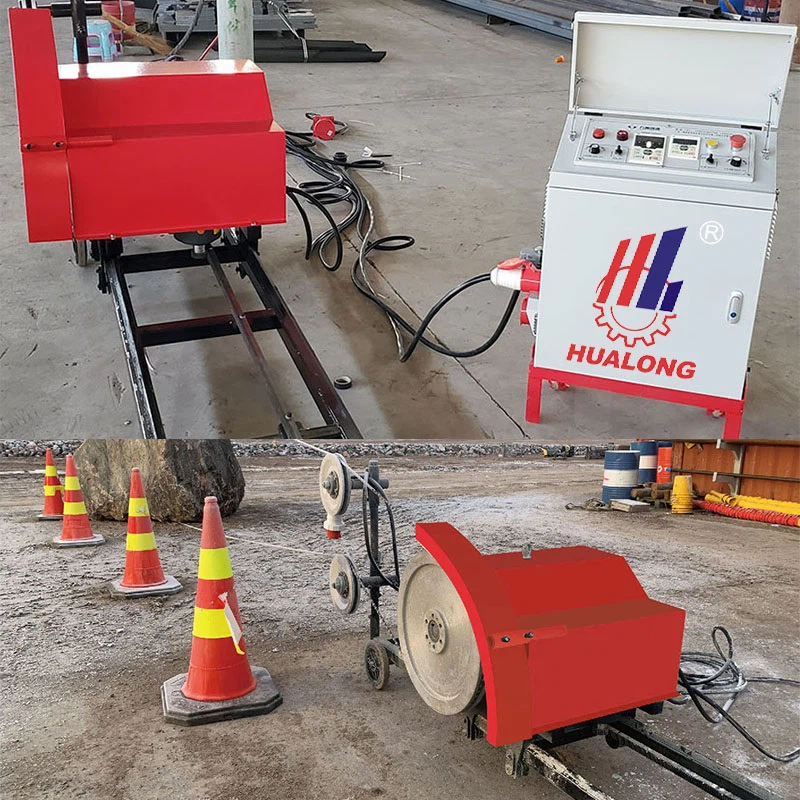
First, let’s set a baseline: a properly maintained wire saw should run smooth, with consistent tension on the wire, even power draw, and no unusual noise or vibration. I always tell clients to start every shift with a 10-minute pre-check—not a rushed walkthrough, but a focused look at the parts that fail most often. Skip this, and you’re setting yourself up for a problem. Let’s start with the most common headache: wire breaks. This is the #1 call I get at 2 a.m., and it’s rarely a random flaw in the wire itself. I’ve tested thousands of spools of wire for my clients, and less than 3% of breaks are from manufacturer defects. Most are preventable.
If your wire breaks mid-cut, stop everything immediately, lock out the power (non-negotiable—never work on a running saw), and inspect where the break happened. If it’s at the guide roller, that’s almost always a sign of wear. Guide rollers are the small, spinning wheels that hold the wire in place as it cuts; over time, their bearings go bad, or their grooves get dinged with rock dust, sand, or small metal shavings from the wire itself. A rough, misaligned groove will fray the wire strand until it snaps. I suggest checking guide rollers every 50 operating hours: spin them with your hand, if they grind or feel stiff, replace the bearing. If the groove is scratched or worn more than 1mm deep, swap the roller. Cheap, quick fix that saves you a whole spool of wire (a 10,000-foot spool can run $800 to $1,200, depending on the grade).
Another common wire break cause is uneven tension. When you start a cut, you set the wire tension to match the hardness of the stone—granite needs 25,000 to 30,000 PSI, marble is closer to 18,000, and soft sandstone is even lower. But over 4 to 6 hours of cutting, that tension can shift. The wire stretches slightly, the guide rollers settle, or the machine’s tensioning spring wears out. If tension drops too low, the wire can slip out of the roller groove, kink, and snap. If it’s too high, it puts unnecessary stress on the welds of the wire segments (most quarry wire is segmented, welded together end-to-end). I teach clients to check tension with a tension gauge every 2 hours during long cuts—you don’t have to get a PhD, just make sure it stays within 10% of the recommended range for your stone. If your machine doesn’t have a digital gauge, I sell mechanical ones that work just as well for half the cost of a service call.
Next up: the saw won’t start, or it shuts off mid-operation. This is the next most frequent call. A lot of new operators immediately assume it’s a bad motor, but I’d say 70% of the time, it’s a power issue. Start at the source: check the circuit breaker for the saw panel. Quarries are dusty, sometimes the breaker trips when a rock shakes the line, or dust builds up on the breaker contacts and causes a power interruption. If the breaker is fine, check the connection between the motor and the control box. Dusty, outdoor conditions mean wires can come loose from vibration, or corrosion builds up on the terminals, blocking power. I once had a client whose saw shut down every time they started cutting granite—we traced it to a loose neutral wire under the control panel, covered in 2 years of rock dust. That took 5 minutes to tighten, no parts needed, and they were back running.
If it’s not power, check the cooling system. Wire saw motors run at high RPM, and they need water or oil to keep them from overheating. Most quarry saws use a water-based cooling system that also flushes rock dust away from the cut area. If the water line is clogged with sediment, the motor overheats and triggers a thermal cutout to prevent damage. I’ve seen motors seized solid because operators ignored a clogged water filter—replacing that filter every 100 hours is non-negotiable. If you’re using an oil-cooled motor, check the oil level monthly; low oil will cause the same overheating shutdown. And for the love of all things quarry, never use rainwater straight from a barrel for cooling—it has minerals that build up in lines and cause clogs. Invest in a basic filtration system, it’s cheaper than a motor rebuild.
Now, what about vibration and noise? If your saw is rattling or making a high-pitched squeal that’s out of the ordinary, that’s a warning sign you can’t ignore. First, check the main mounting bolts for the saw frame. The entire saw head is bolted to the quarry’s work platform, and over time, the constant vibration of cutting will loosen those bolts. I had a client a few years back whose saw was so shaky, it cut an entire block of granite 2 inches off center—we found 3 of the 12 main bolts were completely loose, and one was missing altogether. Torque the bolts to the manufacturer’s specified range (usually 80 to 100 ft-lbs for most mid-sized quarry saws) at every routine maintenance stop.
If the vibration isn’t from loose bolts, check the flywheel. The flywheel is the large, heavy circular part that drives the wire. Over time, its balance can shift—either from wear on the shaft, or from building up rock dust and rust on one side of the wheel. An unbalanced flywheel will cause excessive vibration that wears out bearings, guide rollers, and even the wire faster. You can check balance by running the saw at low speed (make sure the area around it is clear, lock out power if you need to adjust) and feel for uneven movement, or use a simple balance tool. If it’s out of balance, you can have it re-machined, or in some cases, just clean it thoroughly and re-torque the hub bolts. I once had a flywheel that was out of balance because of a quarter-sized rust spot on one side—sandblasting it fixed the vibration, no other work needed.
Noise can also be from the wire itself, or from the feeding mechanism. The feeding system is what moves the saw head forward at a slow, controlled rate as it cuts through the stone. If the feed rate is too fast, the wire is putting too much pressure on the stone, causing friction that makes a loud grinding noise, and leading to premature wear. If it’s too slow, you’re wasting production time, and the wire can sit in one spot and wear unevenly. For granite, the recommended feed rate is usually 2 to 5 mm per minute; marble is faster, around 5 to 8 mm per minute. If the feed is inconsistent, check the feed screw for dirt or worn threads, or the hydraulic system (if your saw uses hydraulics for feeding) for low fluid levels or a clogged filter. I had a client whose feed rate jumped from 3 mm/min to 10 mm/min randomly—turns out the hydraulic filter had been on the same saw for 1,200 hours, and it was completely clogged, causing inconsistent pressure. Changing the filter fixed it in 10 minutes.
Wait, let’s talk about something a lot of operators overlook: the condition of the stone itself and how that affects the saw. I’ve had clients call me saying their saw is “broken” because it can’t cut a particularly hard vein of granite, and it’s not the saw’s fault. Different stone has different compressive strength: a dark granite with high quartz content is much harder than a light marble, and the wire and feed rate need to match. A lot of operators use the same settings for every block, and that leads to premature wire wear and unnecessary stress on the saw. When you get a new block, test a small section first, adjust tension and feed rate, and don’t be afraid to tweak as you go. I always tell my clients: a little bit of adjustment at the start saves a lot of expensive repairs later.
Now, when do you call a specialist (a supplier, like me, or a trained mechanic) instead of troubleshooting yourself? That’s a good question. If you’ve gone through all the steps I listed, and the problem is still there, that’s when you call. For example, if your control panel is flashing an error code you don’t recognize, or the hydraulic pump is making a noise that sounds like it’s grinding metal from inside, or the frame is visibly bent from a heavy impact with a rock, those are problems you don’t want to mess with—they can lead to more damage or even injury. I never mind getting that call; I’d rather help you fix a problem right than have you make a mistake that makes it worse.
I should also add a quick note on routine maintenance, because troubleshooting is half preventing problems before they start. Every 100 operating hours, do a full inspection: replace wire guides, clean the cooling system, torque all bolts, check oil levels, and tension the wire as needed. Every 500 hours, have a trained technician (preferably from the machine’s supplier) do a deeper check: inspect the flywheel balance, test the motor’s power output, check the hydraulic system for leaks, and replace any worn parts before they fail. I offer free maintenance checklists to all my clients, because I know how busy quarry managers are—you don’t have time to memorize every part number, so having a simple list makes it easy to stay on top of things.
Let me wrap this up with a real story, because it drives this home. Last year, I worked with a mid-sized quarry in the mountains of Pennsylvania. They had a new wire saw, and after 3 months of operation, they were averaging one wire break a day, with a 20% downtime rate. Their operator had gone through the basic checks every shift, and he even thought he was changing the guides regularly, but the problem persisted. When I showed up, I first checked where the wire was breaking: every break was exactly 2 feet from the left guide roller. I then pulled the roller off, and under the smooth steel surface, there was a tiny, 0.5mm burr that had formed when the roller was installed at the factory—something the operator couldn’t see with a quick visual check. That burr was fraying the wire strand every time it passed over the roller. I sanded the burr smooth, replaced the guide roller’s bearing as a precaution, and adjusted the tension to match the granite they were cutting. The next month, they had zero wire breaks and a 98% uptime rate. That’s the thing with wire saw troubleshooting: it’s not about complicated tech, it’s about looking for the small, easy-to-miss signs that add up to big problems.

If you’re dealing with a persistent issue with your stone quarry wire saw machine, don’t waste time guessing or risking further damage. Our team specializes in supporting quarries of all sizes, and we can help with troubleshooting, parts replacement, or scheduled maintenance to keep your operation running smoothly. Reach out to our team to discuss your needs—we’re here to help you minimize downtime and maximize productivity.
Waterjet Cutting Machine References
- Quarry Machinery Maintenance Best Practices. International Stone Industry Association.
- Wire Saw Operation and Troubleshooting Guide. Diamond Tools International.
- Hydraulic System Maintenance for Heavy Quarry Equipment. Construction Equipment Association.
- Stone Cutting Machine Performance and Wear Analysis. Journal of Mining Engineering, 2021.
Fujian Province Hualong Machinery Co., Ltd.
Fujian Province Hualong Machinery Co., Ltd. is one of the most professional stone quarry wire saw machine manufacturers and suppliers in China, featured by quality products and good price. Please rest assured to buy high-grade stone quarry wire saw machine for sale here from our factory.
Address: Huangshi Industrial Zone, Putian City, Fujian Province, China
E-mail: jenkin@hualongm.com
WebSite: https://www.stonecuttingmachine.com/
